Why Boutique Gyms Choose Architects Who Understand Revenue Per Square Foot
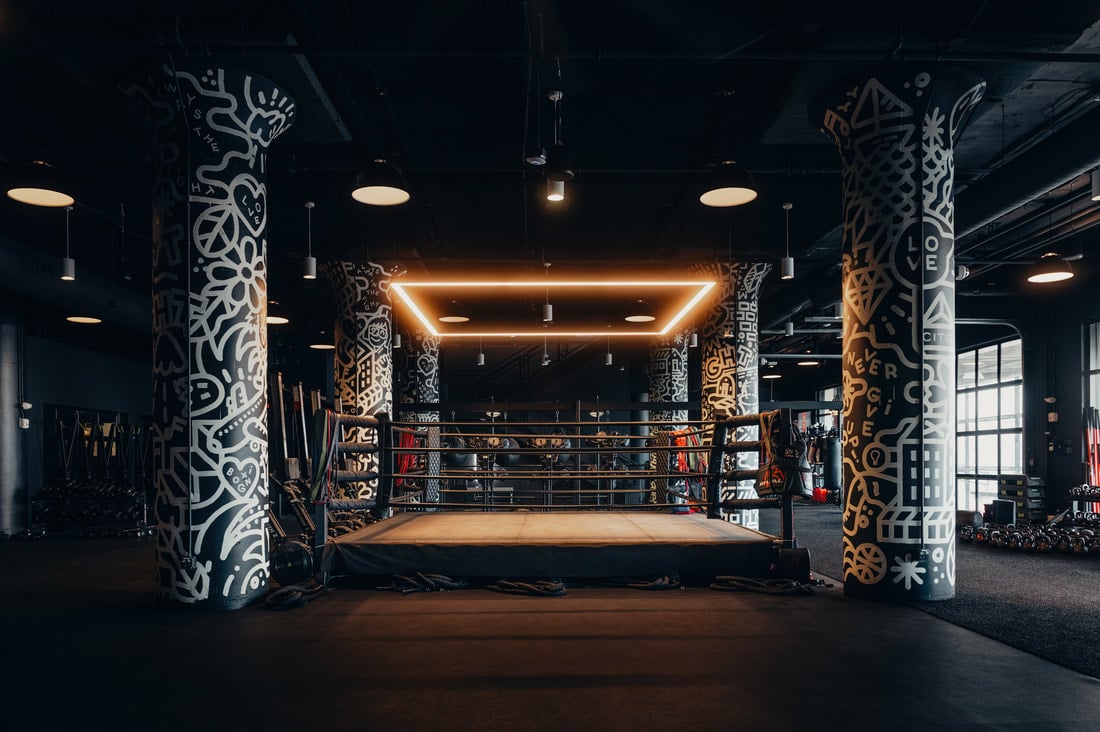
How do you turn 30,000 square feet of raw industrial space into five independent revenue streams? At EBF Drydock, we designed every room — from 50-person circuit boxing to infrared yoga — to earn its keep.
When a boutique fitness operator evaluates a 30,000-square-foot existing gym in Boston, they see opportunity. When we look at it, we see a revenue equation — how many members per class, how many classes per day, how quickly rooms can turn over, and how every square foot performs.
That’s the difference between an architect who designs gyms and one who understands the business of fitness.
From Legacy Gym to Five Revenue Streams
Our work on EBF Drydock in Boston wasn’t about starting from scratch — it was about transforming an underutilized former Reebok gym into a high-performance, multi-format fitness destination.
The brief wasn’t “design a gym.” It was: take 30,000 square feet of existing infrastructure and reconfigure it so every zone produces revenue while the whole operates as a unified brand experience.
The result is a facility with five distinct environments under one roof:
- Circuit boxing gym — engineered for 50-person classes with precise bag spacing to maximize capacity without losing intensity
- Road room — dedicated endurance training, acoustically and spatially separated from high-intensity zones
- Spin room — purpose-built cycling with ventilation designed for rapid turnover between classes
- Infrared yoga studio — a premium recovery offering with higher per-session pricing
- Flexible event space — garage doors allow for private sessions, pop-ups, and overflow capacity
Each room operates as its own revenue stream. Together, they form a membership model where one location competes with multiple specialized studios.
Why Garage Doors Are a Business Decision
The most impactful move at EBF Drydock isn’t a finish — it’s the garage doors. They allow the facility to adapt throughout the day based on demand. A morning yoga class can expand into adjacent space. An evening boxing class can scale from 30 to 50 without relocation.
Static walls create fixed capacity. Flexible partitions create programmable capacity — and programmable capacity means more classes, more formats, and more revenue from the same footprint.
Designing the Brand Into the Architecture
EBF’s dark palette and controlled lighting aren’t aesthetic decisions in isolation — they’re operational. They compress a large footprint into something intimate and focused. They direct attention to the workout. They reinforce intensity.
In boutique fitness, the space is the brand. Members aren’t just paying for access — they’re paying for an experience. Every material, sightline, and transition either reinforces that or dilutes it.
The Adaptive Reuse Advantage
Projects like EBF Drydock show why adaptive reuse is such a powerful strategy in Boston. You’re not starting with a blank box — you’re working within an existing structural and mechanical framework. Done right, that constraint becomes an advantage: faster timelines, lower costs, and character you can’t replicate.
But it requires an architect who understands both:
- The realities of the existing building, and
- The operational demands of a modern fitness business
At Balance Architects, that intersection is where we operate — across fitness, multifamily, and complex conversions.
What to Ask Your Architect
If you’re planning a boutique fitness project, the conversation should start with operations, not aesthetics:
- How does the layout support back-to-back class scheduling? Dead time is lost revenue.
- Where can spaces flex and expand? Fixed walls should be the exception.
- How does HVAC support rapid turnover? A room that takes 20 minutes to reset runs fewer classes.
- Can each zone function as its own revenue stream? The strongest facilities aren’t single-use — they’re portfolios.
The answers will tell you quickly whether your architect is designing a building — or designing a business.